How Can Short-Term Goals Best Lead Towards Accomplishing Long-Term Career Goals?
 Tomas Kauer - Senior News Editor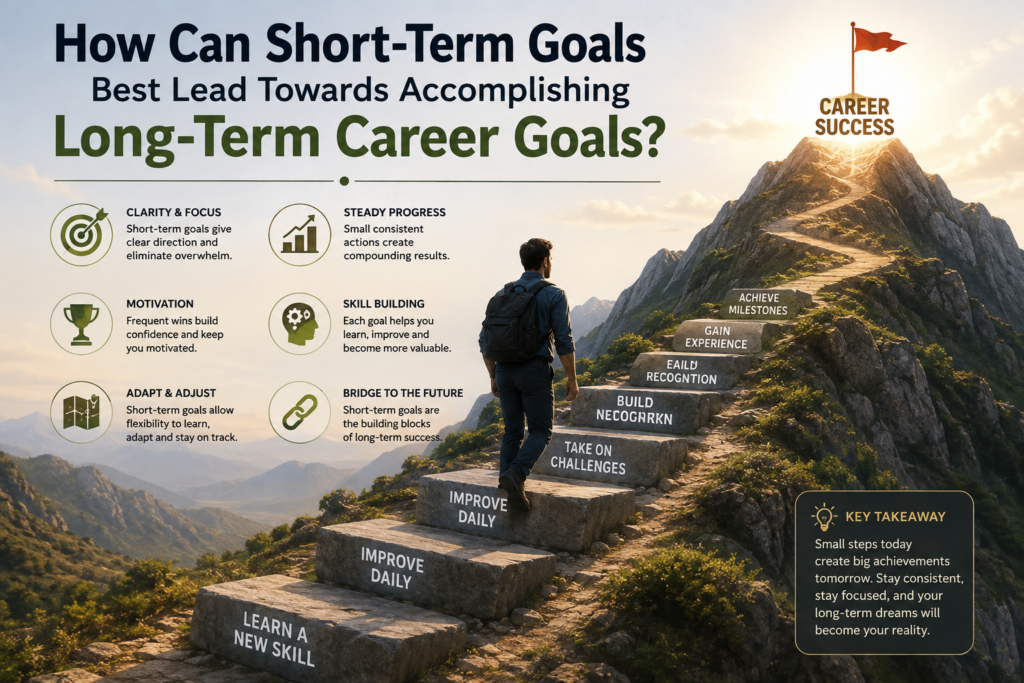
Have you ever set an ambitious 5-year career goal, only to feel lost about where to start? You’re not alone. Research shows that 92% of people abandon their annual goals by the end of January, and most never achieve their long-term career aspirations.
The disconnect isn’t a lack of ambition—it’s the missing link between your big dreams and daily reality. That link is strategic short-term goal setting.
This comprehensive guide reveals how to use short-term goals as a bridge toward accomplishing your long-term career objectives. You’ll discover proven frameworks used by successful professionals, practical examples from various industries, and actionable strategies you can implement immediately.
Quick Answer:
Short-term goals create the foundation for long-term career success by building momentum, developing critical skills, expanding your network, and allowing you to test strategies before major commitments. When aligned properly, quarterly and annual objectives compound into career transformation.
The Critical Connection Between Short-Term and Long-Term Goals
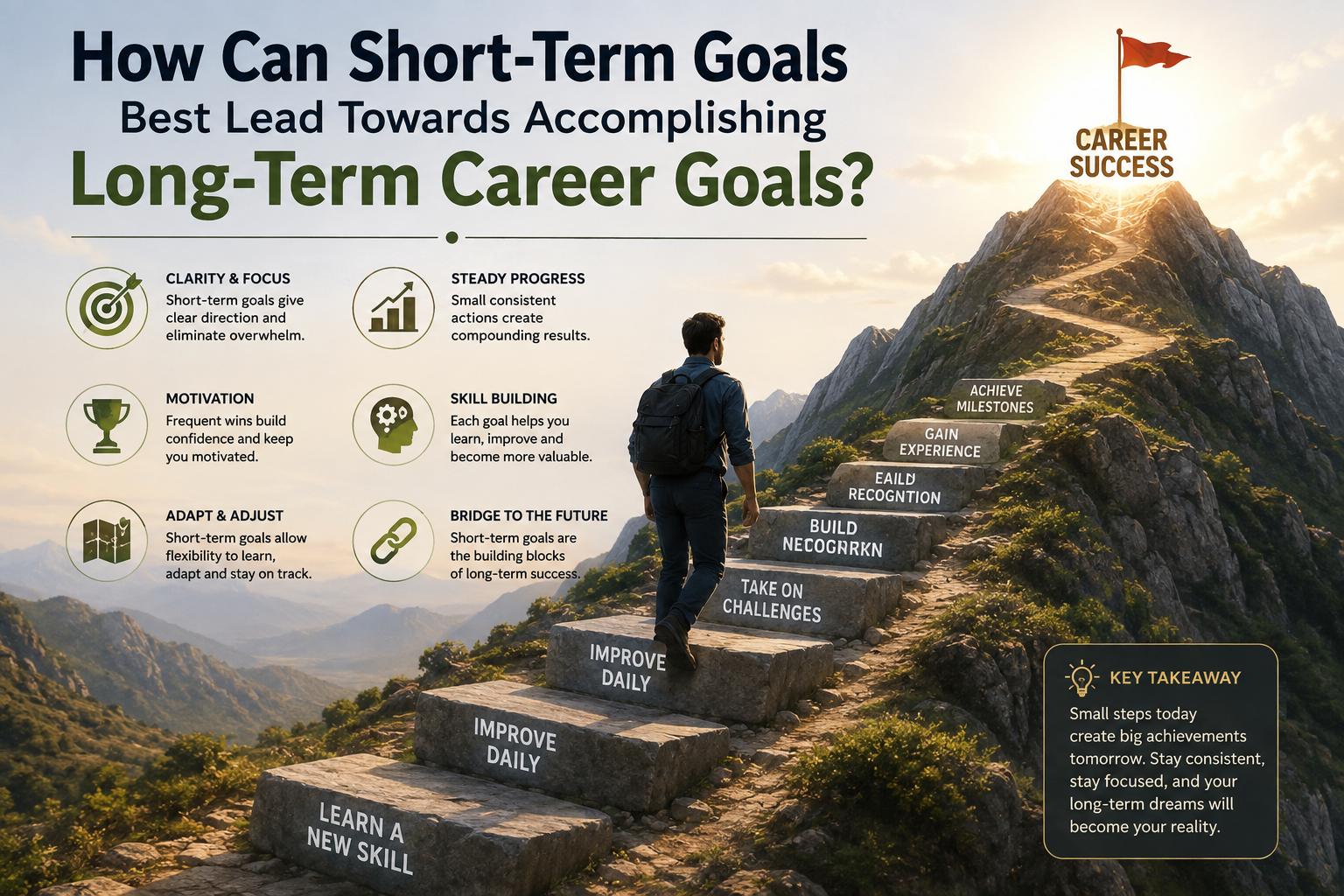
What Are Short-Term and Long-Term Career Goals?
Short-term career goals span 30 days to one year. They include completing a certification, mastering a new skill, landing a promotion, or building a key relationship. These goals are specific, measurable, and achievable within months.
Long-term career goals typically cover 3-5 years or beyond. Examples include becoming a department manager, launching your own business, transitioning to a new industry, or reaching a C-suite position.
The real magic happens when you connect them strategically.
Why Most People Fail Their Long-Term Career Goals
Ambition alone doesn’t create results. People often fail their long-term goals because they:
Skip the middle steps. They want to be promoted to executive level but haven’t built the foundational leadership skills. The gap is too large to cross.
Lack concrete action plans. A 5-year goal feels overwhelming without quarterly milestones. Overwhelm leads to avoidance, and avoidance leads to abandonment.
Lose momentum. Without visible progress, motivation dies. Most people give up before they see meaningful results.
Pursue misaligned goals. They set short-term goals that look good but don’t advance their long-term vision. Progress on these goals doesn’t compound into career transformation.
Strategic short-term goal setting solves all of these problems.
How Short-Term Goals Build Career Momentum
The Psychology of Small Wins
Your brain is wired to respond to achievement. When you accomplish a goal—even a small one—your brain releases dopamine, which increases motivation for the next challenge. This is what psychologists call the “success spiral.”
Short-term goals create regular wins that fuel this spiral. A 90-day goal to complete a certification, build five key client relationships, or lead a cross-functional project gives your brain concrete proof of progress. That proof motivates you to tackle bigger challenges.
Without these regular wins, motivation crashes. After six months with no visible progress on your 5-year goal, most people quit.
Building Skills That Enable Career Advancement
Long-term career goals always require new skills. An engineer who wants to become a technical leader needs communication, mentoring, and strategic thinking skills. A salesperson targeting a VP role needs negotiation, forecasting, and team management capabilities.
Short-term goals let you develop these skills systematically. Instead of trying to learn everything at once, you sequence your skill development strategically.
Year 1, Q1: Master your company’s CRM system completely.
Year 1, Q2: Complete a sales management certification.
Year 1, Q3: Lead your first deal negotiation.
Year 1, Q4: Mentor a junior salesperson.
By year two, you’ve built a skill stack that positions you for advancement. This is deliberate practice—focused learning in specific areas over time.
Expanding Your Network Through Strategic Relationships
Career advancement often depends on who you know. Executives hire people they trust, companies promote people with internal champions, and opportunities flow to people with strong networks.
Short-term relationship goals let you build your network methodically. Instead of vague networking attempts, you set specific targets: “Build meaningful relationships with five industry leaders in Q1” or “Mentor two junior professionals this quarter.”
These relationships compound. A mentor who becomes an advocate can accelerate your career by years. A peer in another department might alert you to opportunities. A junior colleague you mentored might become a future client or partner.
Testing Strategies Without Risk
Your long-term career path won’t be perfectly clear. Market conditions change, industries shift, and your own interests evolve. Short-term goals let you test directions before committing.
Want to see if you’d enjoy management? Lead a small project team. Curious about consulting? Take on a consulting engagement while still employed. Considering a career pivot? Build skills in the new area while maintaining your current income.
These short-term experiments provide real data. You learn what you actually enjoy (not just what sounds good in theory). You build proof points that you can do the work. You identify whether the path is right for you before making major career moves.
The Strategic Framework for Effective Short-Term Goal Setting
Using SMART Goals in Your Career Strategy
SMART goals work because they remove ambiguity. Before setting any short-term goal, ensure it meets these criteria:
Specific: “Improve sales skills” is vague. “Complete Sandler sales training and apply three new techniques in client calls” is specific.
Measurable: “Build my network” is impossible to measure. “Develop meaningful relationships with 10 industry leaders, meeting monthly” is measurable.
Achievable: “Earn an MBA and get promoted to VP and learn four new languages” in 90 days is unrealistic. Break this into achievable pieces.
Relevant: Does this goal advance your long-term career vision? If not, why are you doing it? Every goal should connect to your ultimate objective.
Time-bound: “Sometime this year” is too vague. “By March 31st” creates urgency and accountability.
Setting Goals in 30-Day, 90-Day, and Annual Cycles
Different timeframes serve different purposes:
30-day goals build quick momentum. They’re short enough that you can maintain focus completely. Use 30-day sprints for high-priority skill development or project completion.
90-day goals align with business quarters and are ideal for most career objectives. They’re long enough to accomplish significant goals but short enough to maintain momentum. This is the sweet spot for most career goals.
Annual goals provide the yearly roadmap. These break down into quarterly sub-goals to maintain progress tracking.
The structure looks like this:
- One 5-year career vision
- Five 1-year goals (annual)
- Four 90-day goal sets per year (quarterly)
- Twelve 30-day sprints (monthly focus areas)
This creates a cascade of goals that all support your ultimate vision. Each level enables the next.
The Goal Alignment Checklist
Before committing to any short-term goal, ask these critical questions:
- Does this advance my long-term career goal? If not, it’s a distraction regardless of how appealing.
- What prerequisite skills or accomplishments do I need first? Ensure you’re sequencing goals correctly.
- Do I have the resources and support to succeed? Identify obstacles early.
- Is this the highest-impact goal I could pursue right now? Avoid scattered effort with many mediocre goals.
- Does this conflict with any other current goals? Conflicting goals create frustration and wasted energy.
A goal that fails this checklist is likely to derail your progress, even if it succeeds.
Real-World Examples: How Short-Term Goals Work Across Industries
Technology: Becoming a Technical Lead in 3 Years
Sarah is a mid-level software engineer who wants to become a Technical Lead. Here’s how she structured her short-term goals:
Year 1:
- Q1: Master the company’s most critical legacy codebase
- Q2: Lead architecture decisions on one major feature
- Q3: Begin mentoring two junior developers
- Q4: Present technical findings at team knowledge-sharing sessions
Year 2:
- Q1-Q2: Lead a cross-team technical initiative
- Q3: Complete a leadership course focused on technical management
- Q4: Present to senior leadership on technical roadmap
Year 3:
- Q1-Q3: Lead the architecture for a major new product initiative
- Q4: Apply for Technical Lead promotion
Each goal builds on previous ones. By year three, Sarah has demonstrated leadership, mentored others, influenced architectural decisions, and gained executive visibility—exactly what her company looks for in Technical Leads.
She got promoted on schedule because short-term goals made the path clear and measurable.
Sales: Building an Enterprise Sales Career in 5 Years
Marcus is an Account Executive who wants to become a Regional Sales Director. His short-term goal strategy:
Years 1-2:
- Consistently exceed quota and close enterprise deals
- Build deep relationships with 5-10 key strategic accounts
- Master advanced sales methodologies and negotiation
- Earn all relevant sales certifications
Years 2-3:
- Become top performer and peer mentor
- Manage expansion within existing enterprise accounts
- Participate in strategic account planning
- Take on complex, high-value deals
Years 3-5:
- Earn promotion to Sales Manager or Senior Account Executive
- Build reputation as account strategist
- Develop team management experience
- Position for director-level promotion
After year three, Marcus had proven he could consistently win big deals, manage complex accounts, and influence others. The path to Regional Director was clear because he’d built the capabilities through sequential short-term goals.
Creative Fields: Becoming a Recognized Design Authority
For designers and creative professionals, building reputation matters enormously. Jessica structured her short-term goals around visibility and credibility:
Year 1:
- Complete 10 substantial portfolio projects
- Document each project as a detailed case study
- Publish articles on your design process
Years 1-2:
- Present at industry events
- Start a newsletter sharing design insights
- Network at conferences and through social media
- Build relationships with other respected designers
Years 2-3:
- Secure agency partnership or retainer clients
- Develop recognizable personal brand
- Create signature methodology or approach
Years 3-5:
- Launch your own design studio or consultancy
- Become known for specific expertise
- Command premium rates for your work
The pattern is consistent: visibility through quality work → relationships with peers → positioned for larger opportunities → independence and premium positioning.
Overcoming Obstacles That Stop Goal Achievement
The Misalignment Problem
The biggest obstacle to long-term career success is pursuing short-term goals that don’t advance your ultimate vision. This happens when:
You chase urgent over important. Your boss asks you to lead a project that looks good for your performance review but doesn’t develop skills you need for your long-term goal.
You accept every opportunity. Saying yes to everything feels productive but dilutes your focus.
Your priorities shift without conscious decision-making. You start pursuing a different career path without realizing you’ve abandoned your original goal.
Solution: Create a decision filter. Before saying yes to any opportunity, ask: “Does this advance my career goal?” If the answer is no, either decline or ask how it connects before committing.
Perfectionism Paralyzing Progress
Many high-achievers sabotage themselves with perfectionism. They plan endlessly but never execute because “the plan isn’t perfect yet.”
Perfectionism is the enemy of momentum. A 90-day goal isn’t meant to be flawless—it’s meant to move you forward. Done beats perfect.
Solution: Set a deadline for planning (typically one week). Then execute. You’ll learn more from three months of imperfect action than from three months of perfect planning.
Changing Priorities and Strategic Pivots
Career paths aren’t always linear. Industries change, personal interests evolve, and market conditions shift. You might need to pivot.
The key is distinguishing between a strategic pivot (data-driven course correction) and giving up (fear-driven retreat).
A strategic pivot happens when:
- New information suggests your original path isn’t viable
- You’ve learned you don’t enjoy the direction you were pursuing
- Market conditions change your industry significantly
- A major opportunity emerges that’s better than your original goal
Solution: Make pivot decisions consciously. Ask: “What’s driving this change? Is it data and learning, or fear?” If it’s data, pivot strategically. If it’s fear, push through.
Accountability and Follow-Through Failures
The most common reason people abandon goals is lack of accountability. Unwritten goals tend to stay unaccomplished.
Solution: Write your goals, share them with someone, and commit to monthly check-ins. Accountability dramatically increases follow-through rates.
Tracking Progress and Staying on Course
Effective Monthly and Quarterly Reviews
Monthly reviews keep you connected to progress. Here’s a simple structure:
- Review last month’s goals: Did you achieve them? Why or why not?
- Track leading indicators: What progress did you make toward quarterly goals?
- Adjust tactics: Based on what you learned, what should you change?
- Celebrate wins: What progress did you make?
Quarterly reviews go deeper:
- Did you achieve your 90-day goals?
- What did you learn about yourself, your industry, and your career path?
- Are your goals still aligned with your long-term vision, or should you adjust?
- What should your next quarter’s goals be?
These reviews take only 1-2 hours but keep you on track throughout the year.
Metrics That Actually Matter
Track leading indicators (predictive) rather than only lagging indicators (past results):
Lagging indicator: “I got promoted” (but it’s too late to change if you didn’t achieve it)
Leading indicator: “I completed three leadership development courses and led two cross-functional projects this quarter” (predicts future promotion)
Create a simple dashboard with 3-5 key metrics for your career:
- Skills developed this quarter
- Key relationships built
- Major projects or accomplishments
- Progress toward annual goals
- Performance metrics from your current role
The Mindset That Makes Short-Term Goals Work
Why Consistency Trumps Motivation
Motivation is unreliable. Some days you’ll feel energized and ambitious. Other days, you won’t. People who rely on motivation to achieve goals usually fail.
Successful professionals rely on discipline and systems instead. They don’t wait to feel motivated—they follow their system.
A simple system might be: “Every Monday, I invest three hours in skill development. Every Wednesday, I reach out to two industry contacts. Every Friday, I review my progress.”
This consistency, maintained over years, compounds into dramatic career transformation.
How Delayed Gratification Creates Advantage
Career success requires sacrificing immediate rewards for future gains. You learn a new skill instead of relaxing. You invest in relationships instead of closing deals. You take challenging projects instead of comfortable ones.
Most people lack this patience. They want quick results. This is why so few achieve significant career goals—the people who do are willing to invest years building capabilities.
Building Habits That Support Your Goals
Goals work better when supported by habits. Don’t rely on willpower to achieve your goals—structure your environment and build habits that make progress automatic.
For example, if your goal is to develop leadership skills:
- Habit 1: Read one leadership book per month
- Habit 2: Have coffee with a mentor weekly
- Habit 3: Lead one team meeting or project initiative monthly
- Habit 4: Reflect on lessons learned every Friday
These habits make progress automatic. You don’t have to decide each time—it’s part of your routine.
Frequently Asked Questions (Featured Snippets)
What’s the ideal timeframe for short-term career goals?
Answer: 90 days is ideal for most professionals, with 30-day and annual cycles for additional tracking.
Why: 90 days is long enough to accomplish substantial goals but short enough to maintain momentum and visibility. Quarterly cycles also align with business operations and allow for regular review and adjustment.
How many short-term goals should I pursue simultaneously?
Answer: 3-5 primary goals maximum per quarter.
Why: More than five goals dilute your focus and reduce your success rate. Research shows quality over quantity—fewer goals with full commitment beats many goals with scattered effort.
What if I achieve my goals faster than expected?
Answer: Immediately set new, more challenging goals to maintain momentum.
Why: Achieving goals provides momentum and confidence. Use that energy to tackle bigger challenges rather than coasting. Your next goal should stretch you slightly beyond your comfort zone.
How do I keep my short-term goals aligned with my long-term vision?
Answer: Use the alignment checklist: Does this advance my long-term goal? Does it build required skills or relationships? Is this the highest-impact use of my time? Review quarterly to ensure continued alignment.
What should I do if my industry or interests change mid-goal?
Answer: Evaluate whether this is a strategic pivot (data-driven) or fear-driven retreat. If strategic, adjust your goals consciously. If fear-driven, push through. Either way, make the decision intentionally rather than drifting.
How often should I review my progress?
Answer: Monthly check-ins (30 minutes) for progress tracking and quarterly reviews (2 hours) for strategic evaluation.
Why: Monthly reviews keep you connected to progress and allow for tactical adjustments. Quarterly reviews ensure your direction remains aligned with your long-term vision.
Your 90-Day Action Plan
Ready to transform your career through strategic short-term goal setting? Here’s your implementation plan:
Week 1: Clarify Your Long-Term Vision
Write down your 3-5 year career goal in specific detail. What role do you want? What company or industry? What impact will you have? What will success look like?
Make it vivid and compelling. This becomes your North Star.
Week 2: Identify Your Milestones
Working backward from your long-term goal, identify the 1-year, 2-year, and 3-year checkpoints. What needs to be true at each stage?
This roadmap shows the path from here to your destination.
Week 3-4: Set Your First 90-Day Goals
Define 3-5 specific SMART goals for this quarter. What skills will you develop? What relationships will you build? What projects will you complete?
Ensure each goal connects directly to your long-term vision.
Month 2 Onward: Execute and Track
Execute your plan. Track progress monthly. Adjust tactics as needed. Celebrate wins.
Conclusion: The Compound Effect of Strategic Goal Setting
Short-term goal setting isn’t just about achieving quarterly objectives. It’s about building a system that creates career compounding.
When you set aligned short-term goals, you build skills progressively. You expand your network incrementally. You gain visibility and credibility over time. You test directions and refine your path.
After three years of consistent, strategic short-term goal achievement, you look back amazed at your progress. Your career has transformed in ways that seemed impossible three years ago.
But here’s the key: None of it happened through some grand gesture or perfect timing. It happened through consistent short-term goal pursuit, strategic alignment, and the compound effect of small progress over time.
You have everything you need to achieve your career goals. What you need now is a system—and short-term goal setting is that system.
Start this week. Define your long-term vision. Work backward to identify your first 90-day goals. Share these goals with someone who will hold you accountable. Then execute.
Your future career is being determined by the short-term goals you set today.
The post How Can Short-Term Goals Best Lead Towards Accomplishing Long-Term Career Goals? appeared first on Entrepreneurship Life.