Why AI Transformation Is a Governance Problem, Not a Tech Problem
 Tomas Kauer - Senior News Editor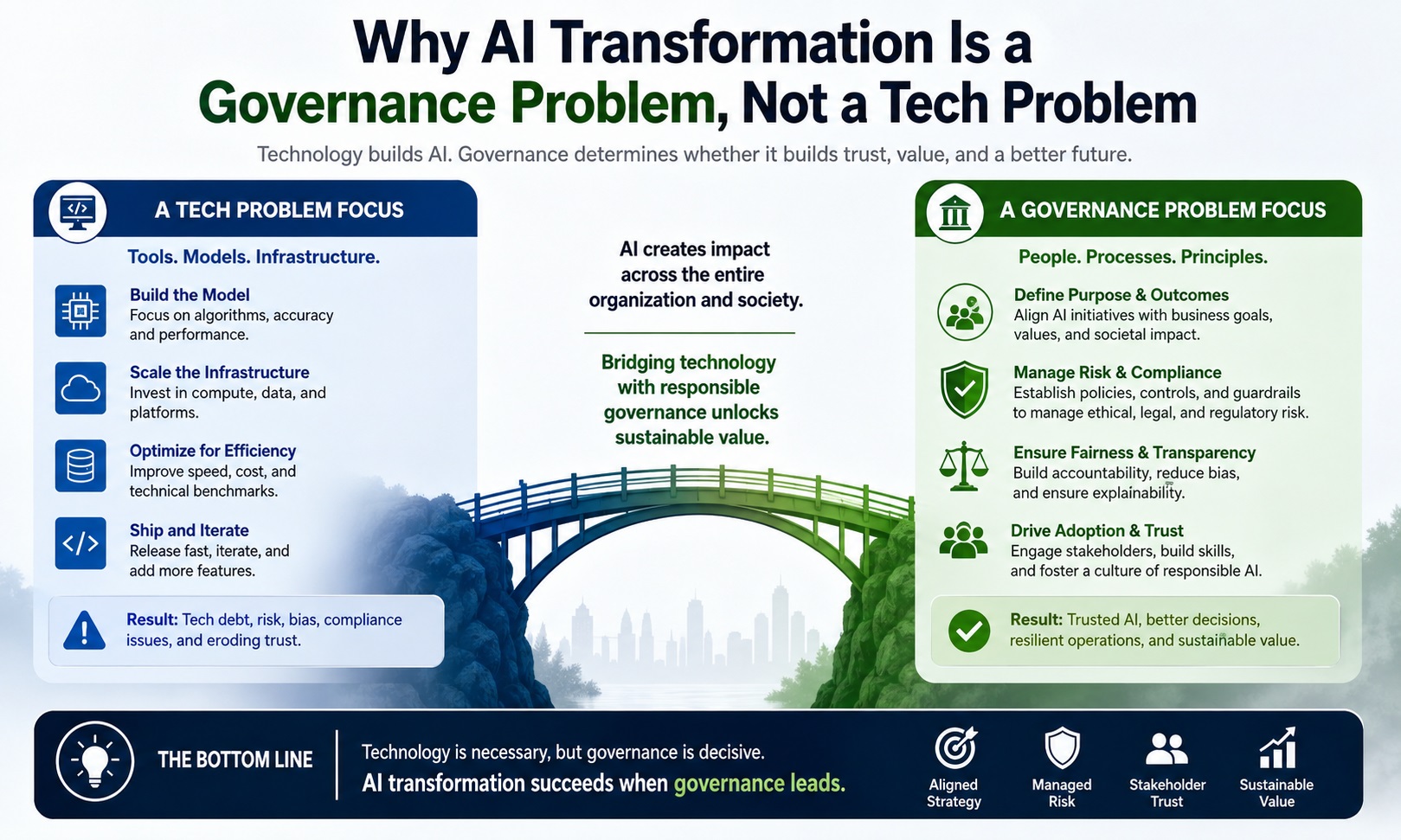
Most companies approach AI transformation the same way they approached cloud migration or the shift to mobile: pick the right tools, hire the right engineers, run a few pilots, scale what works. It’s a logical instinct, and it’s wrong. The organizations struggling to get value from AI in 2026 are rarely struggling because the models aren’t good enough. They’re struggling because nobody decided who owns the decisions the models are now making.
That’s not a technology gap. That’s a governance vacuum.
The Pilot Trap
Walk into almost any mid-sized enterprise today and you’ll find the same pattern: a dozen AI pilots running in parallel, each championed by a different team, each using a different vendor or model, each with its own ad hoc rules for what the AI is allowed to touch. Marketing has a chatbot drafting customer emails. Finance has a tool summarizing contracts. Engineering has copilots writing production code. None of these efforts talk to each other, and none of them are owned by anyone senior enough to make a tradeoff between speed and risk.
This isn’t a failure of ambition. It’s a failure of structure. Pilots multiply because there’s no governing body deciding which one deserves investment, which one needs guardrails first, and which one should be killed. The technology works well enough to ship in every case. The organization just has no mechanism to decide what “ship” should mean.
What Governance Actually Means Here
Governance isn’t a euphemism for compliance paperwork or a committee that exists to say no. In the context of AI transformation, it means answering a small set of concrete questions before deployment, not after:
Who is accountable when the model is wrong? If an AI system drafts a customer communication with a factual error, or a hiring tool systematically deprioritizes a category of candidates, someone in the organization needs to already know it’s their job to catch that, explain it, and fix it. Waiting to assign blame after an incident is not governance — it’s damage control.
What decisions is the AI actually allowed to make, versus recommend? There’s a meaningful difference between a model that drafts a legal clause for a human to review and one that auto-populates contracts sent to customers. Most organizations never draw this line explicitly. They discover where it was only after something goes wrong on the wrong side of it.
How is model behavior monitored over time? Models drift. Data pipelines change. A system that performed well in a pilot three months ago may be quietly degrading now, and without a defined owner checking for that, nobody notices until a customer or regulator does.
What’s the escalation path when something looks off? Frontline employees using AI tools daily are often the first to notice something strange — a pattern in outputs that seems biased, an answer that’s confidently wrong. If there’s no clear, low-friction way for them to flag it, that signal dies at the point of contact.
None of these are engineering problems. They’re organizational design problems, and they require the same discipline companies already apply to financial controls or product safety — just applied to a new category of system.
Why Tech-First Rollouts Stall
The typical failure mode looks like this: a company adopts a powerful model, integrates it into a workflow, and gets genuinely good early results. Then it tries to scale that success across the organization and hits friction that has nothing to do with the model’s capability. Legal won’t sign off because nobody defined data handling rules. Different departments built incompatible processes around the same tool. Employees are quietly avoiding the system because they don’t trust it and don’t know who to ask when it does something wrong. Leadership starts to treat the whole initiative as a technology limitation, when the actual bottleneck was that nobody built the decision-making structure the technology needed to operate inside.
This is the pattern behind a lot of AI transformation stalling in large organizations right now: capable systems, sitting inside organizations that never assigned ownership for how those systems should be used, audited, or trusted.
What Good AI Governance Looks Like in Practice
The organizations getting this right tend to share a few habits, and none of them require exotic technical infrastructure.
They establish a small, cross-functional group — not a slow-moving committee, but a working group with real authority — that reviews new AI use cases before they scale, not after. This group typically includes someone from legal or risk, someone from the business function deploying the tool, and someone technical enough to know what the system can and can’t actually do. Its job is to ask the accountability, permission, and monitoring questions above, quickly, for every new deployment.
They tier their AI use cases by consequence. A tool that summarizes internal meeting notes carries very different risk than one that makes credit decisions or drafts external legal language. Good governance frameworks don’t apply the same level of scrutiny to both — they scale oversight to the stakes involved, so low-risk experimentation isn’t strangled by process built for high-risk deployment.
They build feedback loops directly into the workflow, not as a separate audit function bolted on months later. When something in the AI’s output looks wrong, the person closest to it has an obvious, easy way to flag it, and that feedback actually reaches whoever owns the system.
They treat AI literacy as a governance tool, not a training checkbox. Employees who understand roughly how these systems work — what they’re good at, where they tend to fail, why they sometimes sound confident while being wrong — make better real-time judgment calls than any policy document could specify in advance.
The Uncomfortable Implication
If AI transformation is fundamentally a governance problem, then the executives who should be driving it aren’t necessarily the CTO or the head of engineering. They’re the people who already own accountability structures inside the company: legal, risk, operations, and ultimately the CEO’s office. Technology leaders are essential for evaluating what’s possible and what’s safe to build. But deciding who’s accountable, what’s permitted, and how trust is maintained over time is a leadership and organizational design question — the same kind of question companies have always had to answer when adopting any system powerful enough to make consequential decisions on their behalf.
The uncomfortable part is that governance is slower and less glamorous than deploying a new model. There’s no demo for “we defined clear accountability structures.” But the companies that skip this step aren’t actually moving faster. They’re just deferring the cost of the decisions they didn’t make — and paying it later, usually at a worse moment and with less control over the outcome.
AI transformation doesn’t fail because the technology isn’t ready. It fails because organizations try to bolt powerful new decision-making systems onto old decision-making structures, and expect the structures to hold. They usually don’t. The fix isn’t a better model. It’s a better governance framework built to hold the model accountable to the organization it serves.
The post Why AI Transformation Is a Governance Problem, Not a Tech Problem appeared first on Entrepreneurship Life.